
Collink.3D™ Human
Collagen Bioinks
The Collink.3D™ bioink portfolio is based on methacrylated recombinant type I human collagen (rhCollagen). By harnessing the exceptional properties of rhCollagen—purity, uniformity, and biofunctionality—Collink.3D™ bioinks deliver controlled rheological behavior, high cell viability, and superior biocompatibility.
Collink.3D™ is a recombinant human type I collagen (rhCollagen) methacrylamide, to be used as a curable based bioink material for biofabrication applications, including 3D bioprinting. The product is produced from purified rhCollagen extracted from genetically engineered tobacco plants, that was chemically modified to generate a curable human collagen.
Collink.3D™ formulations can be crosslinked to form hydrogels with diverse properties, for use in a variety of applications. Collink.3D™ is compatible with major 3D bioprinting technologies, i.e., extrusion, inkjet, photolithography, and Laser Induced Forward Transfer (LIFT).
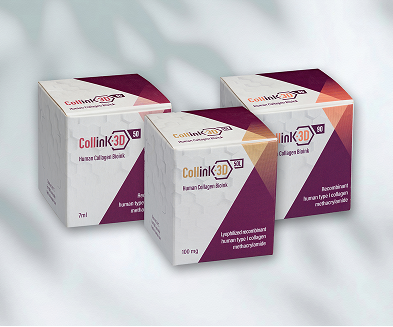
The Collink.3D™ bioink portfolio is based on methacrylated recombinant type I human collagen (rhCollagen). By harnessing the exceptional properties of rhCollagen—purity, uniformity, and biofunctionality—Collink.3D™ bioinks deliver controlled rheological behavior, high cell viability, and superior biocompatibility.
Collink.3D™ is a recombinant human type I collagen (rhCollagen) methacrylamide, to be used as a curable based bioink material for biofabrication applications, including 3D bioprinting. The product is produced from purified rhCollagen extracted from genetically engineered tobacco plants, that was chemically modified to generate a curable human collagen.
Collink.3D™ formulations can be crosslinked to form hydrogels with diverse properties, for use in a variety of applications. Collink.3D™ is compatible with major 3D bioprinting technologies, i.e., extrusion, inkjet, photolithography, and Laser Induced Forward Transfer (LIFT).
Collink.3D™ is a bioink platform material for biofabrication of scaffolds, tissues and organs. Biofabricated constructs composed of Collink.3D™ can be used in a wide range of tissue model applications, including drug discovery, drug screening, disease modeling and tissue testing. In addition, it can be used for the research, development and manufacture of transplantable tissues, scaffolds and organs with complex architectures, to meet specific properties.
Collink.3D™ provides scalable and reproducible biofabrication of tissue models, tissues, and organs, while enabling perfect mimicry of the target native tissues and organs’ properties.
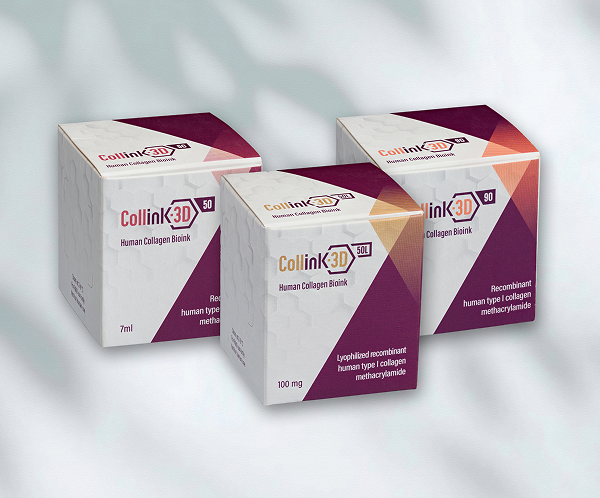
Collink.3DTM is a bioink platform material for biofabrication of scaffolds, tissues and organs for 3D modeling and transplantation. Biofabricated constructs composed of Collink.3DTM can be used in a wide range of tissue model applications, including drug discovery, drug screening, disease modeling and tissue testing. In addition, it can be used for the research, development and manufacture of transplantable tissues, scaffolds and organs with complex architectures, to meet specific properties.
Collink.3DTM is a bioink platform material for biofabrication of scaffolds, tissues and organs for 3D modeling and transplantation. Biofabricated constructs composed of Collink.3DTM can be used in a wide range of tissue model applications, including drug discovery, drug screening, disease modeling and tissue testing. In addition, it can be used for the research, development and manufacture of transplantable tissues, scaffolds and organs with complex architectures, to meet specific properties.
Collink.3D™ provides scalable and reproducible biofabrication of tissue models, tissues, and organs, while enabling perfect mimicry of the target native tissues and organs’ properties.
Collink.3D™ provides scalable and reproducible biofabrication of tissue models, tissues, and organs, while enabling perfect mimicry of the target native tissues and organs’ properties.
Main Advantages
Animal-free
Optimal rheology at room temperature
Supports high viability of different cell types
Biocompatible, non-immunogenic
Collink3D™ also serves as the base component when formulating bioinks.
Adding polymers to the Collink.3D™ will enhance the physical properties and the degradation kinetics of the printed scaffold, mimicking the target tissue.
Incorporating biological components to the bioink formulation, such as ECM molecules (i.e. Laminin, Heparin) dictates the biological performance of the scaffolds. Adding ceramics such as tricalcium phosphate granules supports hard tissue and soft tissues regeneration. Adding nanoparticles or microcarriers enables sustained release of biofunctional molecules.
The unique biological and physical properties of rhCollagen-based formulations provide the flexibility to formulate a broad portfolio of bioinks that are suitable for the production of various tissues and organs. rhCollagen-based formulations can thus offer a superior solution for biofabrication of models and constructs for use in regenerative medicine applications.